
The Model Doesn't Matter Anymore
The harness is the part you actually own. Here are the four layers.

This morning, I woke up to an email my Chief of Staff had written and decided not to send.
It runs on my laptop around the clock, triaging my inbox while I sleep. Overnight, a message came in, and the system read it, understood it, and drafted a reply in my voice that was honestly good enough to send. Then it held the draft instead of sending it. A trust rule routed it into my approval queue, because that sender sits in a category the system has not yet earned the autonomy to answer on its own. No model decided that. A deterministic trust ledger did, the one that tracks how often its drafts survive my edits before it is allowed to act unsupervised.
That small act of restraint is the whole argument of this issue. The intelligence that wrote the reply is the same model anyone can open in a browser tab. The thing that read my real inbox, knew which sender was safe to answer and which to hold, drafted in my voice instead of a generic one, and tracked whether it had earned the right to hit send, none of that is the model. All of it is the harness wrapped around the model.
Same intelligence as the chat window. Completely different machine. That gap is the most underpriced idea in enterprise AI right now, and three of the most expensive moves of the past year were all bets on it.
The Frontier Converged, So the Value Moved
For two years, the industry ran on one assumption. Better model, better results. Every release cycle, we upgraded and felt the jump.
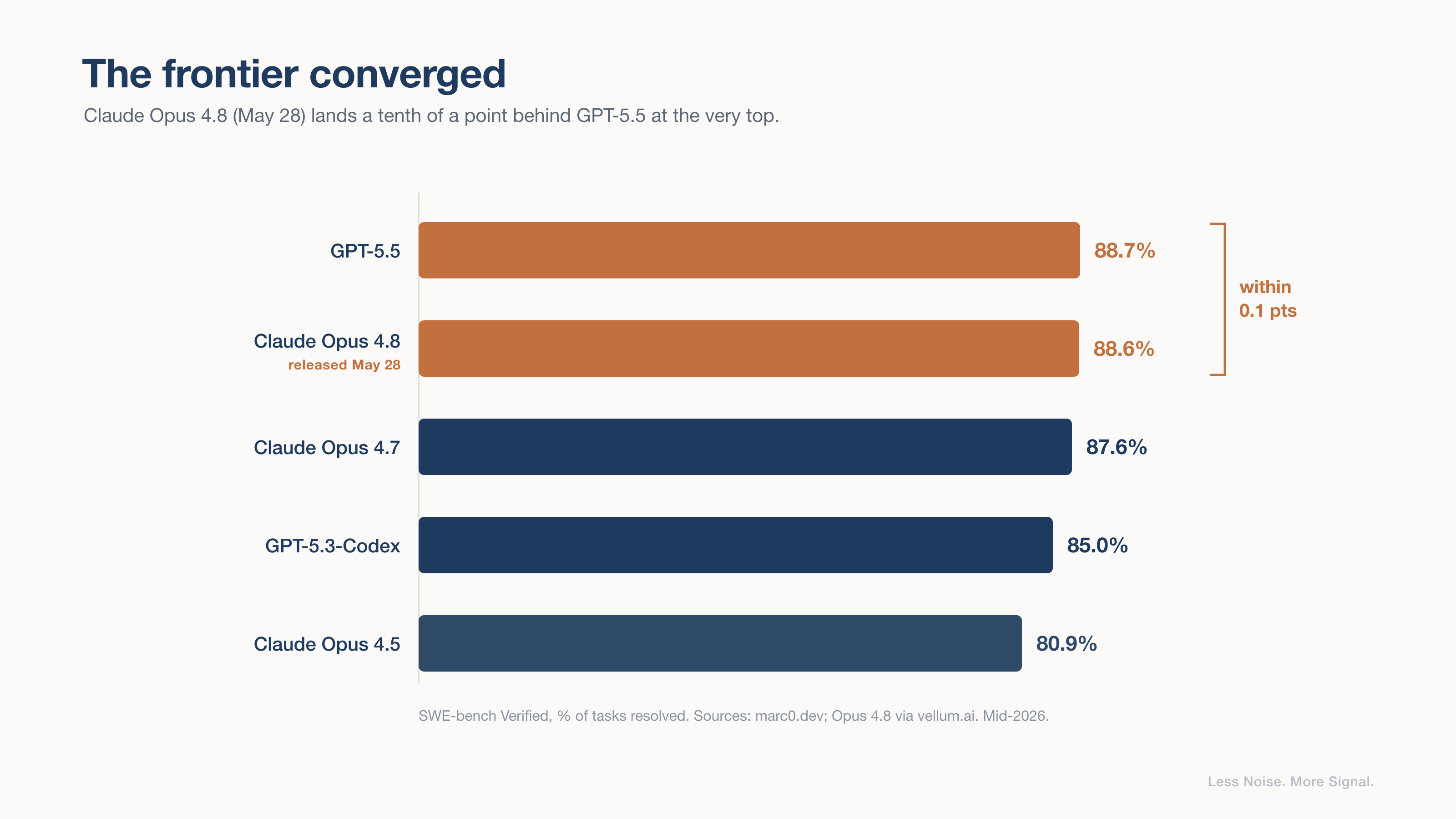
That signal is fading because the frontier converged. Look at SWE-bench Verified, the coding benchmark everyone watches. The top of the board now clusters inside a point or two: GPT-5.5 at 88.7% and Claude Opus 4.8, which Anthropic shipped on May 28 as I was drafting this, at 88.6%, a tenth of a point apart. Opus 4.7 and several others sit a short step behind. On the broad reasoning and knowledge benchmarks the leaders sit within a few points of each other, with arena scores bunched in the same narrow band. The labs themselves stopped leading with those numbers and moved to harder evals, precisely because the old ones no longer separate anyone.
When the models are this close, the model stops being the variable that decides the outcome. Something else does. As one widely shared piece on the new discipline put it, a decent model with a great harness beats a great model with a bad harness. The teams shipping fastest are not running a secret better model. They wrapped a common one in a better harness.
The market has already priced this in, even where the language hasn’t caught up. Three moves make it obvious.
Move one: Anthropic’s Claude Code. By Anthropic’s own Series F disclosures it crossed roughly $500M in run-rate revenue within months of launch, with usage growing more than 10x in a single quarter; later reporting put it past $2.5B by early 2026. And by Menlo Ventures’ enterprise AI survey it now holds an estimated 54% of the enterprise AI coding market, up from 42% six months earlier. The model matters. But the model is also available through a plain API that costs a fraction of this. What people are paying the premium for is the harness around it: the agent loop, the tool access, the terminal, the file system.
Move two: Cursor built its own model. Cursor (Anysphere) shipped Cursor 2.0 in October 2025 with Composer, its own in-house coding model, pitched as “4x faster than similarly intelligent models” and finishing most turns in under 30 seconds. The valuation tells the story: roughly $29B when that round closed in late 2025 on roughly $1B ARR at the time, with revenue tripling past $3B ARR by spring 2026. By May 2026 its Composer 2.5 matched Claude Opus 4.7 on SWE-bench Multilingual, within a point, at roughly one tenth the cost per token. Read that again. The company sitting on one of the most valuable coding harnesses in the world did not try to win the frontier. It co-designed a cheaper model to fit its harness, because the harness was the asset and the model was the part it wanted to commoditize.
Move three: Musk’s companies put a price on it. In April 2026, xAI took an option to acquire Cursor outright for $60B later this year, or pay $10B for the work they are already doing together, while SpaceX struck a parallel partnership to accelerate Cursor’s model training. Musk’s AI lab and his rocket company, together valuing a coding tool in the tens of billions. Not for a model they could rent. For the harness, the workflow, and the developer surface that a model alone can never reproduce.
Three of the most expensive decisions in the category, and not one of them was a bet on a better model. They were bets on the wrapper. The wrapper has a name now. Anthropic’s own engineering blog calls it the harness, and the labs and the investors are already lining up to fight over it. Whatever you call it, the value moved there.
The Harness Stack
A harness is everything between your model and a shipped result. Strip away the branding and every serious one has the same four layers. I call it The Harness Stack. Grade yours on each layer, because one weak layer caps the whole thing.
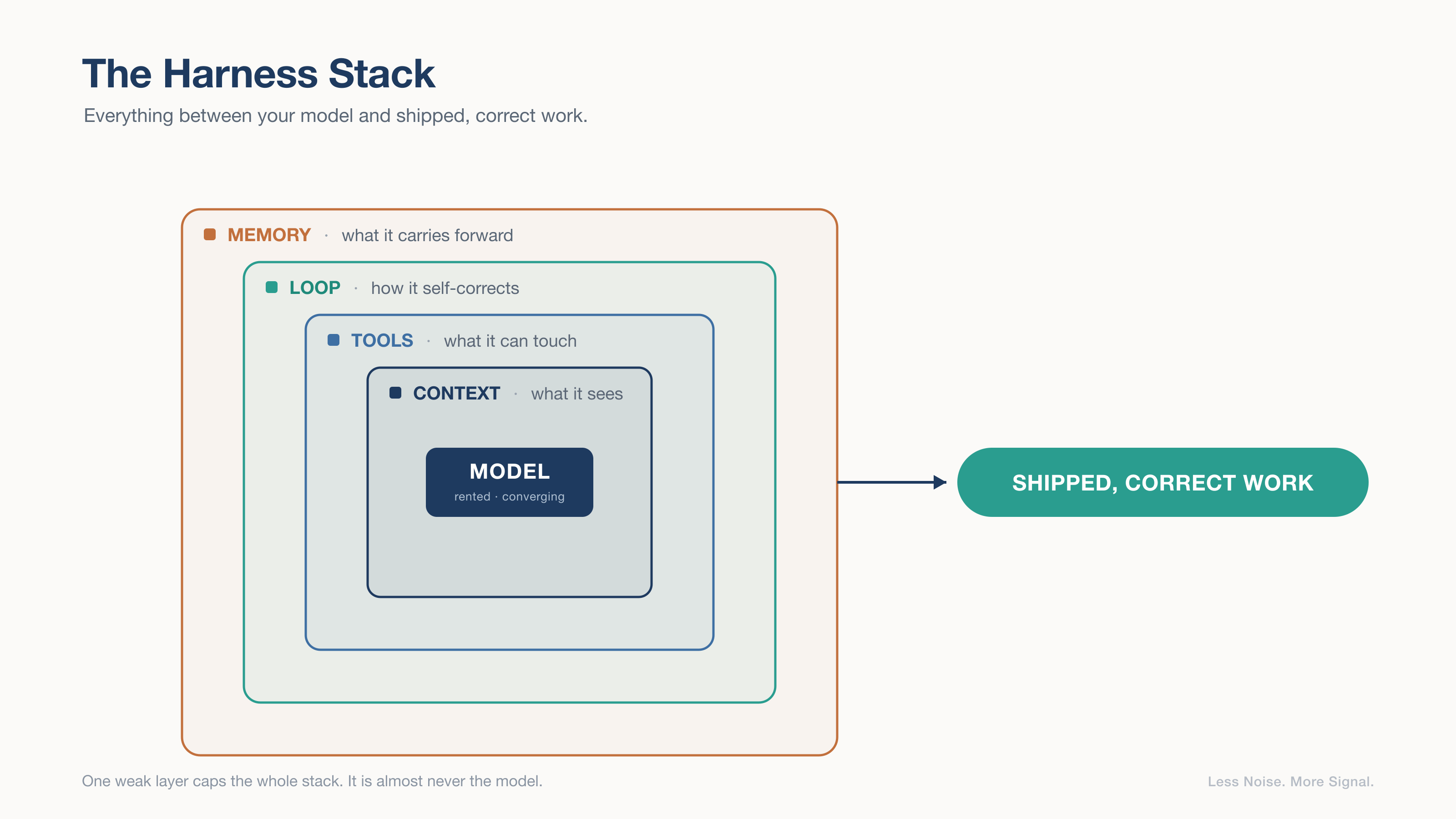
Layer 1. Context: what the model can see. The model is brilliant and blind. It only knows what you put in front of it at inference time. Anthropic calls the discipline of managing this context engineering, “curating and maintaining the optimal set of tokens during inference,” and their own guidance is blunt about why it’s hard. Context is a finite resource with an “attention budget,” and as it fills you get “context rot,” where the model’s recall degrades. The goal is “the smallest set of high-signal tokens.” A chat window makes you paste that by hand, every single time. A real harness assembles it for you: the right files, the dependency graph, the test suite, the past decisions, the house rules. The failure mode is quiet: the model never errors, it just reasons confidently from a stale or partial picture and hands you a clean answer built on the wrong file.
Layer 2. Tools: what the model can touch. A model that can only suggest code is a different species from one that can write it, run it, read the error, and search the codebase. Tools turn a text generator into something that takes action in your environment: file system, terminal, search, and increasingly MCP as the standard connector. This is the single biggest jump from chat to agent, and it has almost nothing to do with model quality. The discipline here is restraint. Ten focused tools beat fifty overlapping ones, because the model can hold the smaller menu in its head. Without this layer you get the most expensive pattern in AI adoption: a model that eloquently describes the fix it would make, while a human transcribes the suggestion by hand.
Layer 3. Loop: how the model corrects itself. Chat is one turn. An agent runs a loop: observe, act, verify, repeat. Anthropic’s own definition of an agent is exactly this, “LLMs autonomously using tools in a loop.” The verify step is where quality actually comes from. A failing test, a type error, a review gate that rejects the draft, a hook that refuses to save the file. Without a feedback signal the model is confidently guessing. With one, it converges. This is the layer most do-it-yourself setups skip, and it’s why their output looks plausible and breaks in production. What good looks like is mundane and decisive: the model writes, a test fails, it reads the failure, and it corrects itself before the output ever reaches you.
Layer 4. Memory: what the model carries forward. A brilliant session that forgets everything by tomorrow is a demo, not a system. Memory is the instruction file that encodes your standards, the logs that persist decisions, the state that lets one run build on the last. It’s what turns a clever assistant into compounding infrastructure. It’s also the layer you most want to own, because a harness whose memory lives only inside someone else’s platform leaves you renting your own accumulated judgment. Skip it and every session reintroduces a mistake you corrected last week. Build it and the system stops making the same error twice.
Context, Tools, Loop, Memory. Most teams have Layer 1 half-built and the other three nearly empty, then blame the model when the output disappoints.
If you’re making the case for harness investment internally, here’s the framing that works: “We are not buying a smarter model. We are building the four layers that turn the model we already pay for into shipped, correct work.”
SAVE THIS: The Harness Stack audit. Score your team 0 to 3 on each layer.
Context: does the model start every task already seeing the right files, rules, and prior decisions?
Tools: can it run, test, search, and act, or only suggest?
Loop: is there a verify step that rejects bad output before it ships?
Memory: does anything persist across sessions?
Your lowest score is your real bottleneck. It is almost never the model.
My Own Harness
Let me make this concrete with the system that produced what you’re reading.
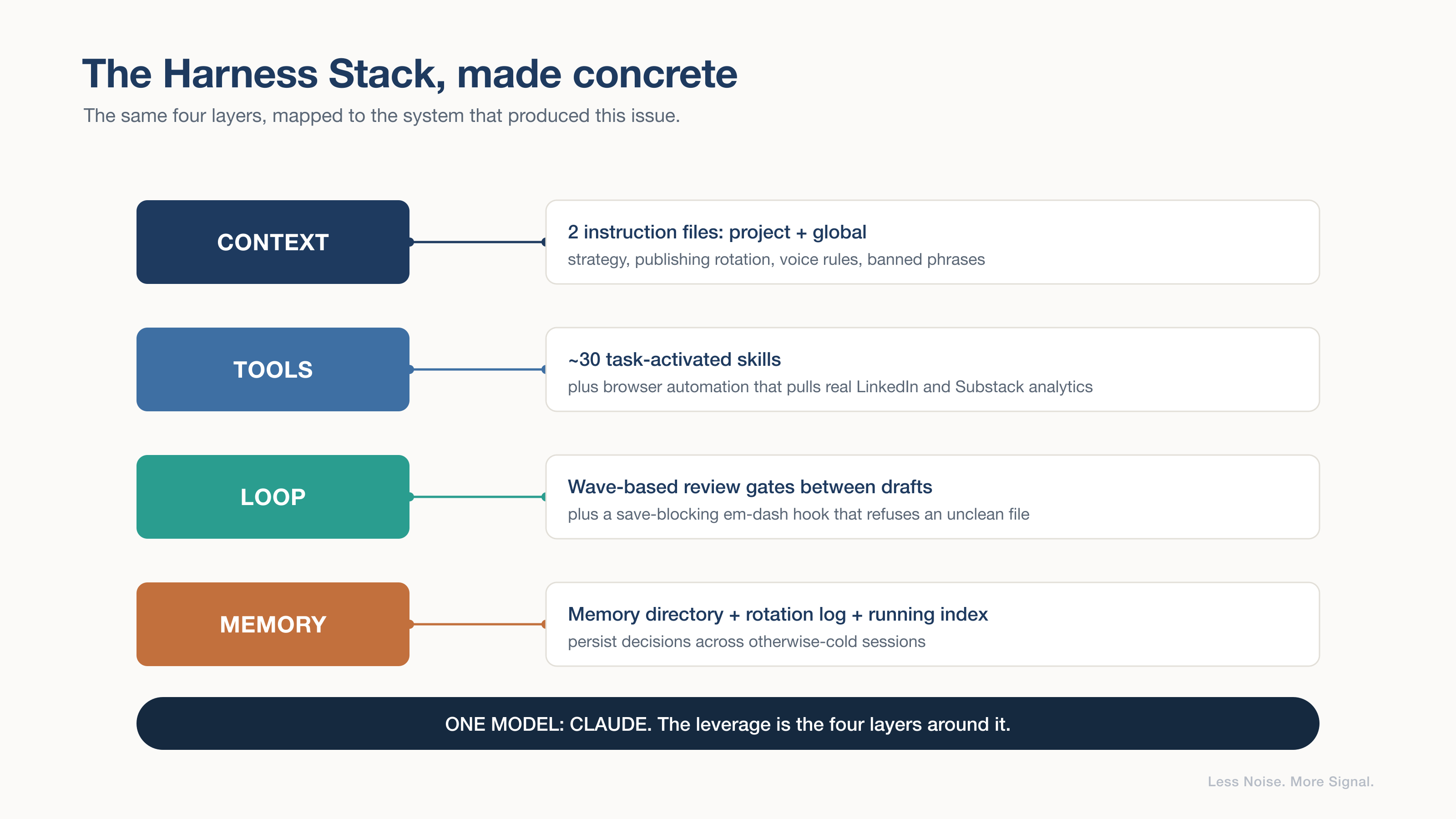
The model is Claude. The harness around it, inside one repository, is built from all four layers:
Context: two instruction files, a project one and a global one, totaling a few hundred lines, that carry the strategy, the publishing rotation, the voice rules, and the banned phrases. The model starts every task already knowing the house style instead of relearning it from scratch.
Tools: around thirty skills that auto-activate by task, plus browser automation that pulls my actual LinkedIn and Substack analytics rather than letting me guess at numbers.
Loop: production runs in waves with review gates between them. A draft is written, then a separate reviewer agent checks it against mechanical rules before the next wave starts. And the smallest loop of all, an em dash hook that refused to save this very file until it was clean.
Memory: a memory directory, a rotation log, and a running index that persist what worked, what’s scheduled, and what I’ve already said, across sessions that otherwise start cold.
Take one concrete example. When a draft needs a number about my own audience, the model will happily produce a plausible one. The harness does not let it stand: a browser tool goes and pulls the real figure from my Substack and LinkedIn dashboards, and a review gate rejects any statistic that arrives without a source. The same model in a browser tab would hand me the invented number with total confidence, and it would ship. The intelligence is identical. The refusal is the harness.
Underneath, five in-conversation subagents and eighteen autonomous agents run on schedules. Same model the whole time. The leverage is not in the intelligence of the model. It’s in how much of my own judgment I’ve encoded into the layers around it.
Here is the part that matters for the argument. You could open the exact same model in a browser tab and reproduce none of this. Not because your model is worse. Because the harness is where the work lives, and the harness is mine.
But Won’t the Next Model Close the Gap?
The obvious pushback: models keep getting better, so won’t a smart enough one absorb the harness, manage its own context, call its own tools, run its own loop? Partly, yes. Every generation folds in a little more of what used to be scaffolding, and that is real progress.
Two things hold anyway. First, whatever the model absorbs, the convergence logic still bites: your competitor rents the same upgraded model the same week you do, so it is never the thing that separates you. Second, the harness is where your judgment lives. Your standards, your data, your definition of done, your rules about what is allowed to ship without a human looking at it. A better model executes that judgment faster and more reliably. It does not supply it. The model gets smarter at answering. The questions of what to build, what counts as correct, and what is safe to automate stay yours, and the harness is where you encode the answers.
What This Means For Your Enterprise
If you lead a team, this changes where you spend.
Stop shopping for the model. Start auditing the harness. The next half point on a benchmark will not fix your output. A missing feedback loop will. Run your team’s setup through the four layers of the Harness Stack and find the empty one. It is almost always Loop or Memory.
Reframe the cost question. Token spend is the wrong thing to worry about first. At a loaded engineering cost of, say, $150 an hour, $500 a month in tokens pays for itself the moment it saves about three and a half hours. The real question is not what the tokens cost. It’s whether your harness converts those tokens into shipped, correct work. A weak harness burns tokens on plausible garbage. A strong one compounds them. Same spend, opposite return, and the harness is the variable.
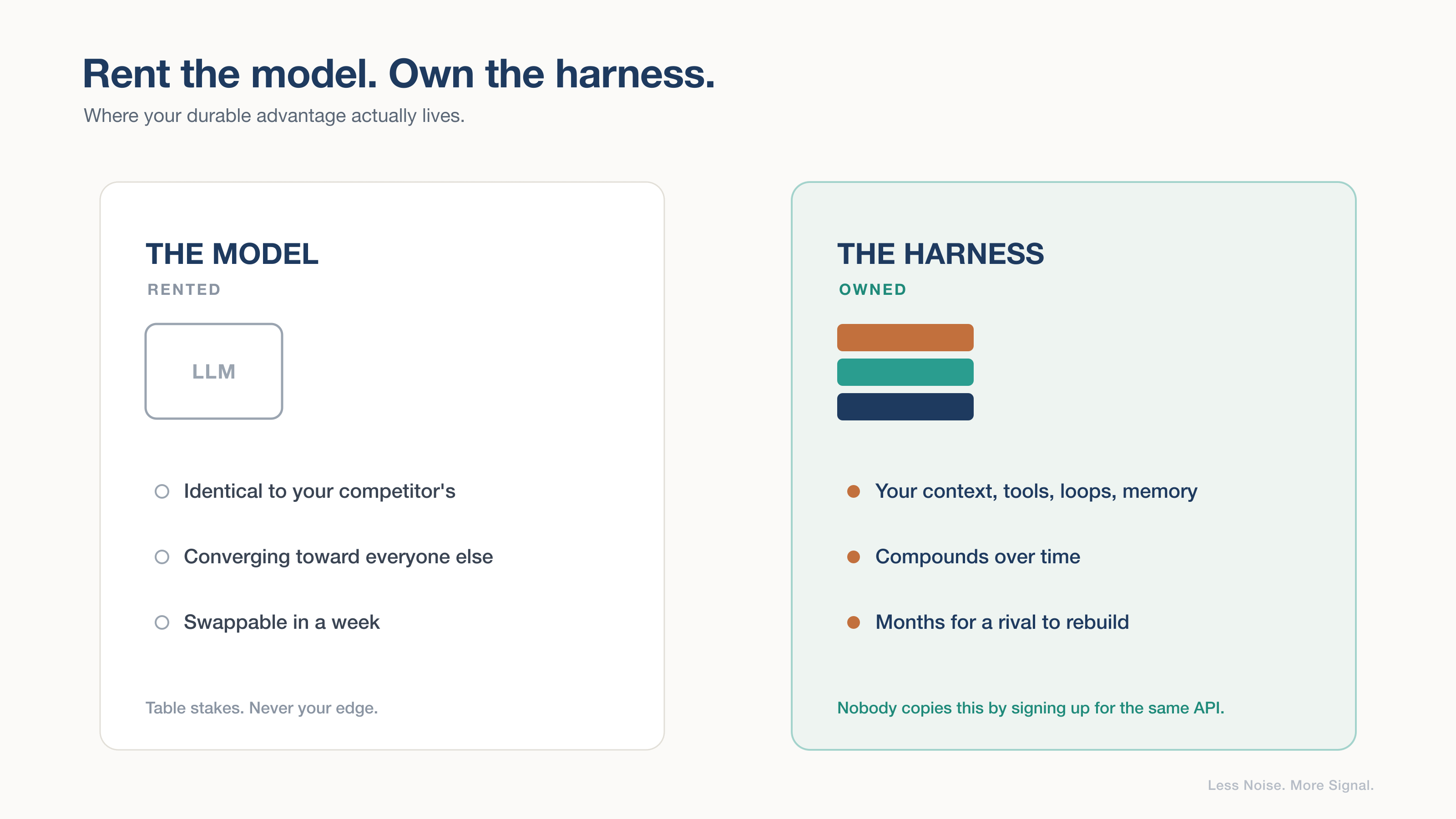
Treat the harness as a durable asset, and own it. A well-engineered harness floats on any model. When a better or cheaper model ships, you swap it in and your context, tools, loops, and memory keep working. That portability is the whole point, and it’s why the memory layer should live somewhere you control, not locked inside a single vendor’s platform. The model is the part you rent. The harness is the part you own.
Make harness engineering a real discipline. Context engineering, tool design, evaluation loops, and memory are engineering surfaces with owners and iteration cycles, not a setting you toggle once. Building a reliable harness takes real, sustained engineering hours. That cost is exactly why it becomes a moat: the model your competitor rents is identical to yours, but the harness takes them months to rebuild.
The model is no longer your constraint. It is table stakes, and it is converging toward your competitors anyway. The harness is the part you actually own, the part that compounds, and the part nobody can copy by signing up for the same API.
The next model is coming. It will be excellent, it will be a point or two better on a benchmark you don’t run, and your competitors will have it the same week you do. The only part of this stack that is yours is the harness. Build that one.
What’s the emptiest layer in your team’s harness right now: Context, Tools, Loop, or Memory? Reply and tell me which one. I read every response, and I’m collecting the patterns for a future issue.
Signal Stack
Quick reads behind this issue, with my one-line take on each.
↑ Anthropic, Effective Context Engineering for AI Agents (link): The clearest articulation of context as a finite resource with an attention budget. This is Layer 1 reading.
↑ Anthropic, Effective Harnesses for Long-Running Agents (link): Notable because the lab itself now uses the word harness. The frame has gone mainstream.
↑ Cursor 2.0, Composer, and the in-house model bet (Cursor 2.0, Composer 2.5 benchmarks, $29.3B valuation and ARR): A harness leader builds a cheaper in-house model tuned for its own loop, matching Opus 4.7 on SWE-bench Multilingual at roughly one tenth the cost. The clearest signal that value moved to the wrapper.
👀 xAI’s $60B option on Cursor, plus a SpaceX training partnership (source): When Musk’s AI lab options a coding tool at $60B and his rocket company joins to train its models, the category has repriced.
↑ SWE-bench Verified leaderboard (leaderboard, Opus 4.8 benchmarks): GPT-5.5 at 88.7% and Claude Opus 4.8 (released May 28) at 88.6%, the top two a tenth of a point apart, with Opus 4.7 just behind at 87.6%. The numbers behind “the frontier converged.”
→ The data behind the revenue and share claims: Claude Code’s $500M run-rate and 10x-in-a-quarter growth come from Anthropic’s Series F announcement; later reporting put it past $2.5B by early 2026. The 54% coding market share figure (up from 42% six months earlier) is from Menlo Ventures’ 2025 State of Generative AI in the Enterprise report. It’s a single VC’s survey sample, so read the methodology before you quote the number.
↓ “Which model is best?” as your first procurement question: Still the opening line in most RFPs, and still the least important one. The model is table stakes. The harness is the decision.
If you’re going to use the Harness Stack to audit your own setup, I want to hear about it. Reply and tell me which layer you found empty.
Know someone building with AI or signing off on AI budgets? Forward this issue, it takes 5 seconds.
Less Noise. More Signal.